19469
Overview
Chemical pesticides face rising resistance, regulatory pressure, and environmental concerns, creating a strong need for safe and biologically sourced alternatives. We discovered that the steroidal saponin Utteroside B is a highly potent natural insecticide, especially against the devastating Colorado potato beetle (CPB). Leveraging newly identified biosynthetic genes (GAME6/8/11/15), Utteroside B can now be produced in engineered plants, enabling a sustainable, “green” solution for crop protection, food preservation, cosmetics, and pharmaceutical applications.
Applications
- Agricultural biopesticide effective against major pests (CPB, Empoasca) through repellence, feeding suppression, and reduced oviposition.
- Post-harvest and food-protection agent preventing insect-related spoilage using a natural compound.
- Cosmetics preservative leveraging saponin-based antimicrobial/insect-deterrent properties.
- Plant-derived protective ingredient for pharma and consumer products.
Differentiation
- Green, plant-derived insecticide avoiding harsh synthetic chemistries
- High potency against CPB and leafhoppers, validated in feeding assays
- Scalable biosynthesis via engineered plants
- Distinct mode of action based on saponin-mediated deterrence, unlike conventional
Development Stage
- Activity established: loss of Utteroside B in GAME15-KO plants results in strong susceptibility to CPB and potato leafhopper, confirming its insect-deterrent role.
- Pathway resolved: the complete biosynthetic route, including defined glycosylation steps, has been mapped and functionally reconstituted in tobacco plants.
- Production demonstrated in engineered plant systems, enabling scalable supply.
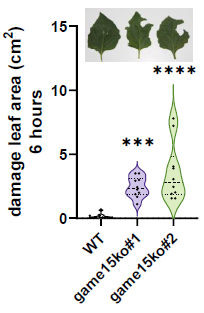
Plants lacking steroidal saponins are highly susceptible to the Colorado potato beetle
Reference

Contact for more information