Quantum computing platforms based on superconducting qubits suffer from high error rates and short storage time of only a few milliseconds, limiting scalable computations. This invention integrates superconducting microwave cavity with a qubit on chip, minimizing lossy surface exposure while enabling high-fidelity quantum gates. By achieving coherence times above 30 ms, over an order of magnitude longer than the state of the art, it enable low-error quantum memories for longer and more complex computations.
- Quantum memory modules in superconducting quantum computers based on Transmon, SNAIL, or Fluxonium qubits.
- Processing qubits in bosonic quantum computers.
- Quantum repeaters for long-distance quantum communication networks.
- Quantum sensors with high frequency resolution.
- Record-long coherence time: >30ms versus 2-3 ms in current devices
- Low-loss cavity design: Reduces photon loss by limiting electric-field surface exposure
- Weakly coupled Transmon lowers decoherence while maintaining fast quantum gates
- Enables bosonic quantum error correction (QEC)
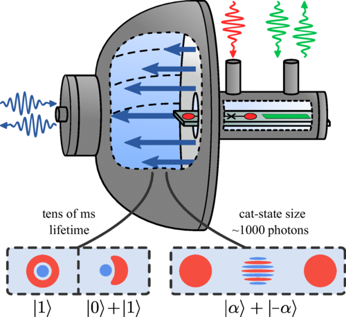
Illustration of the quantum memory
The technology has been demonstrated showing a superconducting quantum memory with a coherence times of 34 ms and photon-lifetime exceeding 25 ms. A proof-of-concept experiment successfully storages large Schrödinger-cat states containing 1,024 photons.